



Vor mehr als dreizehn(!) Jahren hat IHA-Hauptgeschäftsführer Markus Luthe einen Artikel zur Zukunft der Hotel-Distribution verfasst, in dem er nach einem „HotelWiki“ rief. Vielleicht bietet KI nun einen neuen Ansatz für ein globales HotelWiki als Ausweg aus dem Gefangenendilemma?
In Ihrem Gastblog „Winning the AI Era: How Hotels Can Break Free from OTA Dependence“ analysieren Steve Kaufer (Mitgründer von Tripadvisor), Richard Holden (ehem. VP Product bei Google) und Sanjay Vakil (Mitgründer von DirectBooker), wie Künstliche Intelligenz die Vertriebsmacht von Online-Buchungsplattformen (OTAs) infrage stellen kann. Die Botschaft ist klar: Die KI-Ära bietet Hoteliers eine historische Chance, das Reiseökosystem zugunsten der direkten Anbieter zu verschieben. Aber dieses Zeitfenster wird nicht sehr lange offen bleiben. Schnelles Handeln ist geboten, bevor sich das Verhalten der Reisenden verfestigt, exklusive Geschäftsverträge abgeschlossen werden und die OTAs zum Standardkanal der KI-Suche werden.
Autoren*: Steve Kaufer, Richard Holden, Sanjay Vakil
Der Wandel hin zur Nutzung von KI-Tools durch Reisende bietet sowohl für Verbraucher als auch für die Hotelerie eine einzigartige Chance, sich von der Abhängigkeit von großen Online Buchungsplattformen (OTAs) zu lösen.
Während KI kurz davorsteht, viele Aspekte der Reiseplanung zu transformieren, ist sie (bisher) in ihrer Fähigkeit eingeschränkt, Reisefragen zu beantworten, wenn Genauigkeit oder Detailtiefe entscheidend sind. Um diese Einschränkung zu umgehen, beginnen KI-Unternehmen, Partnerschaften mit bestehenden OTAs einzugehen, die strukturierte, zwischengespeicherte Daten liefern können, die Reisende zur finalen Planung benötigen. Doch die einzigartigen Preise, Konditionen und Vorteile, die nur bei Direktbuchungen über die Webseiten der Hotels verfügbar sind, fehlen bei den OTAs. Diese verfügen in den meisten Fällen außerdem nur über eingeschränkten Zugang zu Beständen und Verfügbarkeiten der Hotels.
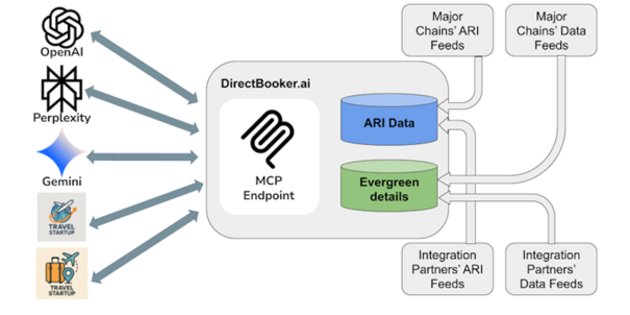
Ein neuer KI-nativer Integrationsstandard namens Model Context Protocol (MCP) schafft die Möglichkeit eines anderen Weges. Mithilfe von MCP kann ein hotelspezifischer Aggregator den KI-Unternehmen dieselben Vorteile wie OTAs bieten – strukturierte, zwischengespeicherte, aktuelle Daten, die Reisende für ihre Entscheidungen benötigen. Und – besser als eine OTA – kann ein solcher Aggregator zudem einen umfassenden Hotelbestand über Ketten und unabhängige Häuser hinweg vereinen und genaue Daten zu Verfügbarkeit, Preisen und Beständen (ARI) in großem Maßstab bereitstellen. Er kann auch Preise und Angebote anzeigen, die ausschließlich bei Direktbuchung verfügbar sind und damit ein besseres KI-Erlebnis für die 70% der Reisenden ermöglichen, die direkt buchen wollen.
Um erfolgreich zu sein, muss ein solcher Aggregator Daten von Hunderten Partnern abrufen und zwischenspeichern, diese Informationen in einem für KI-Systeme verarbeitbaren Format bereitstellen und sie mit der notwendigen Leistung und globalen Skalierbarkeit liefern. Das erfordert technische Expertise und weitreichende, partnerschaftliche Beziehungen mit unabhängigen Hotels, Hotelketten und Integrationspartnern. Aus diesem Grund haben wir DirectBooker gegründet.
Online-Reisen und der Kontext der KI-gestützten Neuordnung des Ökosystems
Um zu verstehen, wie KI die Reisesuche verändern wird, betrachten wir den heutigen “Planungstrichter”: Die meisten Reisenden beginnen mit dem Träumen, verfeinern ihre Entscheidung durch Recherche, planen dann spezifische Details ihrer Reise und führen schließlich eine Buchung durch.
Heute ist Google der wichtigste Einstiegspunkt für jede dieser Phasen. Die Suchmaschine zeigt organische Ergebnisse und bezahlte Anzeigen an. In der Traum-, Recherche- und Planungsphase wollen Reisende eine umfassende Auswahl. Google weiß das und optimiert seine Suchergebnisseiten entsprechend, was OTAs bevorzugt, die ein großes Hotelangebot präsentieren. Mit ausgeklügeltem Performance-Marketing und hochoptimierten SEO-Strategien haben OTAs diesen Vorteil genutzt, um mehr Traffic zu kaufen, mehr Buchungen zu erzielen und hohe Provisionen von den Hotels zu verlangen. Einzelne Hotels oder Ketten können kaum mithalten, da sie nicht die Bandbreite an Optionen bieten, die Reisende zu diesem Zeitpunkt ihrer Suche erwarten.
Die Dominanz der OTAs hindert Reisende zudem daran, die besten Angebote zu finden. Belastende Vertragsbedingungen zwischen OTAs und Hotels schränken die Transparenz ein und verhindern, dass Hotels die besten Preise direkt präsentieren können. Verschärft wird das durch das faktische Oligopol der beiden größten OTAs, eine Realität, die von zahlreichen Regulierungsbehörden weltweit stillschweigend hingenommen wird. Weitere Anbieter im Reisesuchmarkt sind oft finanziell von OTAs abhängig und daher nicht bereit, die Vorteile der Direktbuchung hervorzuheben.
KI als neuer Einstiegspunkt für Reisen
KI wird zum neuen Einstiegspunkt für Reisende – mit transformativer Wirkung in mehreren Phasen der Reise, jedoch auch mit Schwächen. Besonders stark ist KI bei allgemeinen Empfehlungen und Inspirationen – aber schwach, wenn es auf Genauigkeit ankommt.
Träumen: Generative KI kann inspirierende Bilder, Videos und Reisepläne erzeugen. Genauigkeit ist hier zweitrangig.
Recherche: KI kann zeitlose Inhalte auswerten, um Aktivitäten und Orte zu empfehlen. Details wie die Nähe eines Hotels zur Skipiste oder ob es einen beheizten Pool gibt, bereiten jedoch Schwierigkeiten.*
Buchung: Agentenbasierte KI kann auf einer einzigen Seite Buchungsschritte simulieren, aber nicht hunderte Optionen auf mehreren Seiten vergleichen.
* LLMs verwenden eine Form der verlustbehafteten Kompression – Details werden oft weggelassen. Selbst große Modelle können Schwierigkeiten mit spezifischen Fakten haben. Zu viele Details führen zu Pseudo-Überanpassung, was Halluzinationen begünstigt.
Am meisten scheitert KI an der Planung – also der Auswahl der Unterkunft. Hier sind Echtzeitdaten zu Verfügbarkeit, Preis und Konditionen essenziell. Diese Daten ändern sich ständig und sind nicht gut komprimierbar – was die Stärken von Sprachmodellen überfordert.
500.000 Hotels × 330 Datumspaare × bis zu 10 Raten ergeben 300 Milliarden Preispunkte, die sich täglich ändern. Diese Daten passen nicht in ein KI-Grundmodell. Um dieses Problem zu umgehen, wird eine Technik namens Retrieval Augmented Generation (RAG) genutzt. Dabei wird externe Information, durch Crawling oder gezielte Abfragen, vor der Antwortgenerierung eingebracht. Dies bringt aktuellere, präzisere Antworten.
Allerdings lassen sich Echtzeitinformation, insbesondere Preise, kaum effizient crawlen. Hotels blockieren Live-Scraping aus Kosten- und Lastgründen. Selbst Google musste dafür eigene Systeme entwickeln, um ARI-Daten direkt von Partnern zu erhalten. KI-Agenten, die Live-Daten crawlen wollen, werden blockiert – wie heute schon Bots auf Ticketing-Websites.
Daher suchen KI-Unternehmen nach strukturierten, zwischengespeicherten, aktuellen Datenquellen. Erste Partnerschaften in diesem Bereich bestehen bereits, z. B. OpenAI mit Booking.com oder Perplexity mit Tripadvisor. OTAs sind dabei naheliegende Partner, können aber nur begrenzt Daten liefern:
Eingeschränkter Bestand: Nur Hotels mit OTA-Vertrag.
Eingeschränkte Verfügbarkeit: Nur Zimmer, die für OTAs freigegeben sind.
Eingeschränkte Angebote: Viele Hotels bieten bessere Direktbuchungskonditionen.
Solange es aber keine bessere Alternative gibt, bleiben die OTAs auch in der KI-Welt dominant
Das Model Context Protocol (MCP) eröffnet einen besseren Weg: Es erlaubt die Bereitstellung strukturierter Informationen an KI-Systeme über ein offenes Standardprotokoll. So entsteht Wettbewerb unter Datenquellen und KI-Systeme können die genaueste und aktuellste Quelle auswählen.
Auch mit MCP werden KI-Anbieter weiterhin mit Aggregatoren statt mit einzelnen Hotels arbeiten. Diese Aggregatoren bündeln Daten von Hunderten Partnern – ein erheblicher Vorteil gegenüber Einzelhotels. MCP schafft Raum für einen KI-nativen, hotelaffinen Aggregator, der vollständige ARI-Daten von Hotels bereitstellt – im Gegenzug für Direktbuchungs-Weiterleitungen. So können Reisende in der Planungsphase umfassend vergleichen und trotzdem direkt buchen.
Vorteile für alle Beteiligten:
Reisende erhalten umfassende Verfügbarkeit, Angebote und Hotelübersichten.
KI kann individuelle Vorteile direkt vergleichen.
KI-Anbieter bieten differenziertere, bessere Erlebnisse.
Hotels sparen OTA-Provisionen und pflegen direkte Kundenbeziehungen.
Dies ist eine historische Chance, das Reiseökosystem zugunsten der Anbieter zu verschieben.
DirectBooker – ein KI-nativer, hotelaffiner Aggregator
Wir haben DirectBooker gegründet, um diese Chance zu nutzen. Unsere Mission: Reisende direkt mit Hotels verbinden. Unser Team hat jahrelange Erfahrung im Reisebereich und im Betrieb auf Internetmaßstab. Wir haben Hunderte Datenfeeds aufgebaut, Petabytes an ARI-Daten zwischengespeichert und weltweit Preise bereitgestellt.
Jetzt tun wir es erneut. Wir sehen die Gelegenheit, die KI und MCP schaffen, und wissen, wie man sie realisiert. Hotels können über unseren Aggregator individuelle Angebote an Reisende richten – mithilfe von KI. Mitgliedspreise, Treueprogramme, verbundene Zimmer oder früher Check-in könnten zum Buchungsgrund werden.
Mit Unterstützung aller drei großen KI-Anbieter für MCP wird DirectBooker Datenfeeds aufbauen, Inhalte zwischenspeichern und genaue Informationen in großem Maßstab liefern. Wir wissen, wie man ARI-Daten von Ketten und Partnern integriert und in KI-verdaulichem Format bereitstellt, weltweit und skalierbar. Direkt an den Interessen der Hotels ausgerichtet, wird DirectBooker umfassendere Listen, vollständige Verfügbarkeiten und die besten Angebote bereitstellen – direkt von den Hotels. Als genaueste und vollständigste ARI-Datenquelle werden wir zum Standardendpunkt für die KI-basierte Reisesuche.
Über die Autoren Steve Kaufer, Richard Holden, Sanjay Vakil
Steve, Richard und Sanjay haben zusammen über 50 Jahre Erfahrung in der Online-Reisebranche, der Hotelsuche und der Reiseplanung als Führungskräfte von Tripadvisor, Google Travel und jetzt DirectBooker.
Winning the AI Era: How Hotels Can Break Free from OTA Dependence
BySteve Kaufer, Richard Holden, Sanjay Vakil
The shift to travelers using AI tools presents a unique opportunity for both consumers and the hotel industry: a chance to break free from dependence on the large Online Travel Agencies (OTAs).
While AI is poised to transform much of travel planning, AI is limited in its ability to answer traveler questions when information accuracy or detail is critical. To address this limitation, AI companies have begun to forge partnerships and integrations with existing OTAs, who can offer some of the structured, cached data that travelers need to finalize their travel plans. But the unique prices and benefits available when booking directly with hotels are unavailable on OTAs, and OTAs have more limited inventory and availability information than travelers could potentially get from the hotels themselves.
A new AI-native integration layer called the Model Context Protocol (MCP) has created an opportunity for a different path forward. Using MCP, a hotel-aligned aggregator can offer the same advantages to AI companies as OTAs – providing structured, cached, real-time data that travelers need to make decisions and book. And – better than an OTA – such an aggregator can also unify comprehensive hotel inventory across chains and independent properties, presenting accurate Availability, Rates, and Inventory (ARI) data at massive scale. It can also offer prices, offers, and benefits that are only available to those booking directly with hotels, enabling a better AI experience for the 70% of travelers who prefer to book direct.
To succeed, this aggregator must be able to pull data and cache feeds from hundreds of partners, surface that information in formats AI systems can consume, and serve it with the performance and global scale needed by the emerging AI entry points. This requires technical sophistication and extensive, friendly commercial relationships with independent hotels, integration partners, and chains. That’s why we’ve created DirectBooker.
Online Travel and the Context for AI’s Reinvention of the Ecosystem
To understand how AI will change travel searches, consider the travel planning funnel today. Most travelers start with Dreaming, refine their decision making with Research, then proceed to Planning specific aspects of their trip, and, finally, Booking.
In today’s ecosystem, Google is the primary entry point for each stage of travel search, a process that surfaces both organic search results and sponsored ads. Travelers at the Dreaming, Research, and Planning stages want a comprehensive list of results to consider. Google understands this and optimizes for this intent, an approach that favors OTAs, who offer a large selection of hotels for travelers to consider. With sophisticated performance marketing teams and highly optimized Google SEO strategies, OTAs have historically leveraged this advantage to buy more traffic, win more bookings, and extract large commissions from the hotels they represent. Individual hotels or chains cannot successfully compete because they lack the range of options travelers are looking for when they Dream, Research, and Plan.
OTA dominance also prevents travelers from finding the best offers for their needs. Onerous contractual obligations between OTAs and hotels dramatically reduce transparency between booking channels, preventing hotels from showing travelers the best rates. This is exacerbated because the two largest OTAs are an effective oligopoly, a reality that has been tacitly acknowledged by regulatory bodies worldwide. Other players in travel search are dependent on the majority of their revenue from OTAs and so are unwilling to showcase the benefits of booking directly.
AI as the New Travel Entry Point
AI is set to become the new entry point for travelers and can be transformative at several stages of the travel journey, with some notable limitations. In particular, AI tools are strongest when they offer broad strokes and overarching take-aways – and weakest when accuracy or detail is required.
Dreaming: Generative AI can create inspirational imagery, videos, and itineraries. At this stage, it doesn’t need highly accurate data – general destination knowledge is sufficient.
Research: AI can mine evergreen content to recommend what to do and where to go. Notably, however, it struggles with the granular details travelers need – like whether a hotel is near ski slopes or has a heated pool.*
Booking: Agentic AI tools can streamline booking on a single site by following steps to simulate traveler actions. But these tools can’t scale to compare hundreds of options across many sites.
Companies whose businesses are reliant on these stages will have to change dramatically or be swept aside.
* LLMs are a form of “lossy compression” where details are often removed. Somewhat counterintuitively, even large foundational AIs with billions of parameters can struggle with granular, specific facts. While these models are trained to recognize patterns across vast data, they aren’t designed or optimized to reliably store or retrieve detailed information. Attempting to encode too many such specifics can lead to a kind of pseudo-overfitting, where the model confidently recalls incorrect details, increasing the risk of hallucinations.
The stage where AI struggles the most is in Planning (selecting where to stay), because accuracy at this stage is non-negotiable. Travelers need real-time data: inventory, prices, and availability for specific dates. This dataset is constantly changing, and because it isn’t easily compressible or predictable, it doesn’t play to LLMs strengths. For example,
500,000 hotels × 330 date pairs × up to 10 room rates leads to 300 billion price points, most of which change daily. This data cannot be encoded in foundational AI models. To deal with this limitation, AI companies add information into the query before attempting to generate a result via a technique called Retrieval Augmented Generation (RAG). The information is retrieved by crawling web pages or by explicitly querying other data sources. RAG provides the newest information and fine-grained details to the AI’s machinery. Providing this information to the “context window” allows more accurate, detailed, and up-to-date answers.
RAG is typically used in conjunction with crawling websites, but crawling for certain kinds of information – namely prices or information that is updated in real time – doesn’t scale or is simply impossible. Hotels don’t want to allow expensive, live scraping for prices and availability if a booking is unlikely to result. Even Google, with its sophisticated crawling infrastructure, had to build custom systems to ingest ARI data directly from travel partners. AI agents attempting to crawl this data “live” will be blocked (as bots already are on ticketing sites) because of the loads, costs, and risks they impose on hotel websites and infrastructure.
Instead of crawling, Foundational AI companies are seeking existing sources of structured, cached, real-time data to query. They have already started forging partnerships and implementing custom integrations with travel industry giants: OpenAI with Booking.com, Perplexity with Tripadvisor, amongst others. These OTAs are obvious initial partners, as they are able to fill in some, but not all, of the detail consumers need.
While OTAs are a convenient partner, they aren’t the best partner for AI companies, or for travelers who want to use AI tools. The data that OTAs can provide falls short in several important ways:
Limited inventory: OTAs only list hotels with whom they have commercial agreements.
Limited availability: OTAs can only list rooms hotels choose to sell via OTAs.
Limited offers: Many hotels will offer better deals for direct bookers, so OTAs don’t consistently have the best offers.
Nevertheless, the same legacy OTAs who were the winners in the search ecosystem will remain the winners in the AI ecosystem, until there is a better option.
Model Context Protocol (MCP) provides an opportunity for a different and better path forward, one that can give travelers more of what they want by surfacing a richer set of data about the unique deals and benefits that hotels can offer. MCP is a new AI-native integration layer, an open standard that allows companies to provide structured information to foundational AIs. It allows competition between data sources and makes it possible for AI systems to pull from the endpoint that offers the most current, accurate, and comprehensive data, in turn allowing them to craft the very best responses to queries.
Even with MCP, foundational AI companies are still going to work with aggregators rather than individual hotels. To avoid entering into and managing commercial and technical agreements with hundreds of partners in an ecosystem, they will partner with a small number of technology-savvy companies to provide the data needed for RAG. Companies that aggregate data from the widest range of hotels or other travel data sources will continue to hold a powerful advantage over individual hotels or chains.
What MCP creates is an opportunity for an AI native, supplier-aligned aggregator to enter the marketplace, one that hotels can use to showcase their complete ARI data, in exchange for direct booking referrals. AI companies can use this aggregator to bridge the Planning gap with complete inventory and offers that come directly from hotels. And the 70% of travelers who want to book directly can access both the comprehensive list they want for Planning and the direct relationship with the hotel they want.
Aggregating data directly from hotels results in substantial benefits for players across the travel ecosystem:
Travelers have access to a truly comprehensive list of offers, availability, and hotels
Travelers can use AI to compare, evaluate, and access the unique benefits that only the hotels themselves can provide.
AI companies can provide unique, differentiated, and ultimately better experiences to the 70% of travelers who want to book directly with hotels.
Suppliers can create direct relationships with travelers and save on the massive commissions currently charged by OTAs.
All this adds up to a generational opportunity to delight travelers and shift the ecosystem towards suppliers.
DirectBooker, an AI Native Supplier-Aligned Aggregator
We started DirectBooker to seize this opportunity. Our mission is to connect travelers who want to book directly with hotels who want to delight them. Our team is exceptionally experienced in the travel industry and operating at internet scale. We’ve built hundreds of feeds, cached petabytes of ARI data, and served accurate prices at the largest travel websites on the planet.
Now, we’re ready to do it again. We see the window of opportunity that AI and MCP has created and we know how to execute on it. Hotels will be able to use our supplier-aligned, AI native aggregator to tailor their best offers to individual consumers, using AI to customize offers, rather than limiting themselves to the generic offers in OTAs’ inventory. Member rates, loyalty programs, the availability of adjoining rooms, or the possibility of an early check in could all be offered or become the decisive factor in reserving a room.
With all three major AI players now supporting MCP, DirectBooker will build feeds, cache data, and serve accurate content at a massive scale. We know how to integrate ARI data across hundreds of chains and integration partners to provide truly comprehensive inventory. We have the technical acumen to keep up with the rapidly evolving world of AI integrations, to serve results in an AI ingestible format, and to serve them at a scale that can handle the anticipated loads.
Because it is directly aligned with the interests of and partners with hotels, DirectBooker will surpass what the OTAs are able to provide by showing a comprehensive list of hotels, complete availability inventory, and the very best offers, all sourced from the hotels themselves. Functioning as the most accurate and comprehensive source of ARI data, we will earn the position of the default endpoint to all popular AI travel search entry points.
About Steve Kaufer, Richard Holden, Sanjay Vakil
Steve, Richard and Sanjay have combined over 50 years experience in the online travel, hotel search and travel planning as leaders from Tripadvisor, Google Travel and now, DirectBooker.

 min
Lesezeit
min
Lesezeit
 14
Kommentare
14
Kommentare



July 17 2025 10:55 am von Gabriele Schulze / Gabriele Schulze marketing4results.de
Sehr geehrtes DirectBooker-Team,
vielen Dank für den interessanten Blogbeitrag – spannend zu sehen, wie sich Ihre Plattform entwickelt.
Beim Besuch Ihrer Website https://www.directbooker.com ist mir aufgefallen, dass ich kein Impressum finden konnte. Daher hätte ich ein paar Fragen, bei denen Sie mir hoffentlich weiterhelfen können:
Wo befindet sich der Unternehmenssitz von DirectBooker?
Wie kann ein Individualhotel die Daten für MCP bereitstellen?
Wie finanziert sich Ihre Plattform – und welche Kosten entstehen für die Vermittlung über DirectBooker?
Ich danke Ihnen im Voraus für Ihre Rückmeldung und sende
freundliche Grüße
Gabriele Schulze
July 17 2025 3:14 pm von Sanjay Vakil
> Where is the headquarters of DirectBooker located?
We're located in Boston, MA.
> How can an individual hotel provide data for MCP?
We typically work with your integration partners rather than hotels directly. We've been in contact with many of them and have had very favorable conversations.
> How is your platform financed – and what are the costs for booking through DirectBooker?
We're aiming to have a simple "CPC" model where we get paid a very small amount for each prospective guest we send to your site.
April 22 2026 12:38 pm von
April 22 2026 12:38 pm von
April 22 2026 12:38 pm von
April 22 2026 12:38 pm von
April 22 2026 12:38 pm von
April 22 2026 12:38 pm von '
April 22 2026 12:38 pm von
April 22 2026 12:38 pm von
April 22 2026 12:38 pm von
April 22 2026 12:38 pm von
April 22 2026 12:38 pm von
April 22 2026 12:38 pm von
Kommentar hinzufügen