


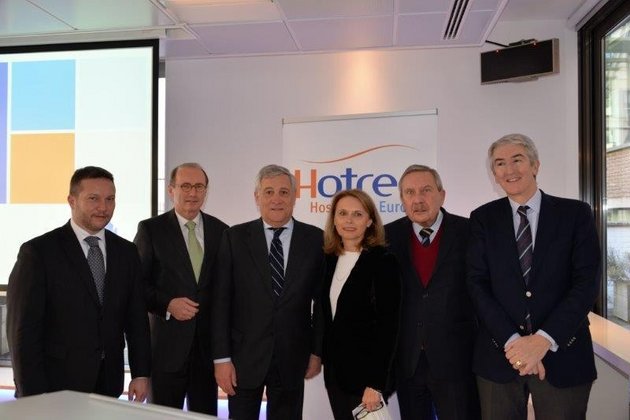
Brussels, 30 November 2016 – Today, in an event co-hosted by MEP Karas and MEP Ujhelyi, with participation of European Parliament Vice-President Tajani, hospitality industry leaders called upon the necessary policies to make tourism an even stronger driving force for job creation and growth.
The European hospitality industry represented amongst others by Mr Jean-Marc Banquet d’Orx, Chair of the HOTREC Sectoral Social Dialogue Committee, recalled that the industry created 2.5 million jobs between 2000 and 2010 (29% growth versus 7% in the overall economy) and still keeps creating thousands of jobs every year. Nevertheless, several obstacles common to SMEs in various sectors hinder further rise, such as the shortage of skills, the too high tax wedge on labour and the digital challenges. Furthermore hospitality is suffering from a lack of attractiveness of the sector.
"Today, we learnt that the shortage of skills leads to tens of thousands of jobs being unfilled every year, while 20% of Europeans aged under 25 years are unemployed. Moreover, the competitiveness of the 1.7 million micro-sized enterprises of the sector is affected by the unfair competition from the uncontrolled development of the so called collaborative economy. Therefore, the European Union must fund massive trainings, and create a level playing field for all tourism providers" commented European Parliament Vice-President, Mr. Antonio Tajani.
Participants also raised the issue of labour costs which too often impede hospitality businesses to recruit, although needs are massive. "Taxation schemes should not be an obstacle to invest in new workforce. Therefore, public authorities should reflect on strategies to tackle profit shifting from multinational corporations to be able to reduce the taxation burden away from labour, ensuring a competitive tax environment for tourism services" explained MEP Othmar Karas, Chair of the SME intergroup. "Indeed we should take better advantage of the potential for job creation and growth inherent to the tourism sector" he added.
Participants lastly recalled that the industry is an entry door to the job market especially for people aged under 25 years who hold 20% of the jobs. It is also a factor of social inclusion as 33% of the jobs are held by relatively unskilled people. However, the sector suffers from a lack of attractiveness despite strong recruitment needs in particular in ICT. "It becomes now urgent for public authorities and the tourism sector to partner together to jointly promote the attractiveness of the tourism sector, in order to benefit in particular from the increasing demands from China. Reaching this we need concrete actions, pilot proposals, like the World Bridge Tourism and the European Capital of Tourism projects. As initiator of these projects I encourage the tourism sector to support them" concluded MEP István Ujhelyi, Vice-President of the European Parliament TRAN Committee.
------------------------------------------------
What is HOTREC?
HOTREC represents the hotel, restaurant and café industry at European level. The sector counts in total around 1.8 million businesses, being 99,5% small and medium sized enterprises (91% are micro enterprises, i.e. employing less than 10 people). These businesses make up some 60% of value added. The industry provides some 10 million jobs in the EU alone. Together with the other tourism industries, the sector is the 3rd largest industry in Europe. HOTREC brings together 43 national associations representing the interest of this industry in 29 different European countries.
For further information: www.hotrec.eu
PRESS CONTACT: Alexis Waravka +32(0)2 504 78 43, alexis.waravka@hotrec.eu
What is UEAPME?
UEAPME is the employers’ organisation representing exclusively crafts, trades and SMEs from the EU and accession countries at European level. UEAPME has 80 member organisations covering over 12 million enterprises with 55 million employees. UEAPME is a European Social Partner. For further information please visit http://www.ueapme.com/ or follow @UEAPME on Twitter.
For further information: www.ueapme.com;
PRESS CONTACT: Jenny Manin, +32(0)496 520 329, pressoffice@ueapme.com