



As the European umbrella organisation for hotels, bars, cafés and restaurants in Europe, HOTREC believes that the Digital Services and Markets Acts, presented on 15 December by the European Commission, are an opportunity to level the playing field, tackle illegal offers of services and give hospitality SMEs more control over their digital presence.
“Most hospitality establishments’ would currently describe their relationship with online platforms as one-sided and dependent. Today’s announcement by the European Commission gives hoteliers hope that this relationship can become genuinely bilateral, where establishments engage with platforms on an equal footing”, said HOTREC Director General Marie Audren.
She added: “We are optimistic that the European Parliament and EU Member States can, under the Digital Services and Markets Acts, support the creation of a conducive environment for small businesses that want to be in control of their digital distribution strategies.”
Hospitality establishments and hotels in particular largely depend on platforms to obtain bookings and reservations. Online Travel Agents (OTAs) have grown tremendously over the past two decades, with roughly 30% of all hotel room bookings made online via an OTA intermediary in 2019. This share has grown by 10 percentage points since 2013. The devastating impact of the Covid-19 crisis on the hospitality sector has further increased the sector’s reliance on these platforms.
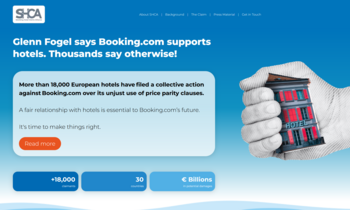
OTAs are unavoidable business partners for hotels and play every trick in the book to maintain a strong relationship of dependency for hoteliers. Today, a hotelier is not equipped to challenge price parity clauses, unilateral changes to terms and conditions and constricted access to guest and marketing data generated by transactions that concern that hotelier, among other issues.
Any attempt by a hotelier to break free from online travel agents’ rules is met with what amount to sanctions in practice, such as downgrading, dimming or even removing offers of services. Hoteliers however have no means to retaliate to unfair treatment from OTAs other than ‘David vs Goliath’ litigation, where OTAs have much deeper pockets than a family-run hotel to pay for legal fees upfront.
One single platform, Booking.com, accounts for over 65% of hotel bookings made via OTAs in Europe. Most other OTA platforms replicate the practices and behaviour of the dominant platform, which gives hoteliers very little choice in practice between competing platforms.
HOTREC also welcomes new rules under the Digital Services Act ensuring that platforms are accountable for content and the introduction of new data sharing requirements. This is a must to ensure that ‘what is illegal offline is also illegal online’, with platforms taking responsibility and liability for the role they exert. HOTREC believes such rules are key to tackle offers of short-term rental accommodation which do not meet local, regional or national legal requirements.
For further information: www.hotrec.eu
Press Contact: Alessia Angiulli, +32 (0)2 504 78 45, alessia.angiulli@hotrec.eu